Key Visual - Abrasives

Abrasives

Compact Honing Stones

In view of our current ecological and economic challenges it becomes apparent: Honing with diamond or boron nitride cutting shoes is indispensable in modern production processes.

Numerous factors determine the honing result. The ideal composition of the honing stone and all other influencing factors to the honing process need to be coordinated in order to achieve optimal end results. High production quality, short cycle times and longevity of the tools are achieved in this way.

Defining a suitable honing stone is the task of our specialists with many years of practical experience in the most diverse of applications in the entire field of honing technology.

Honing stone

In principle, the perfect honing stone consists of three different main components, which offer the required cutting properties as a uniform whole.

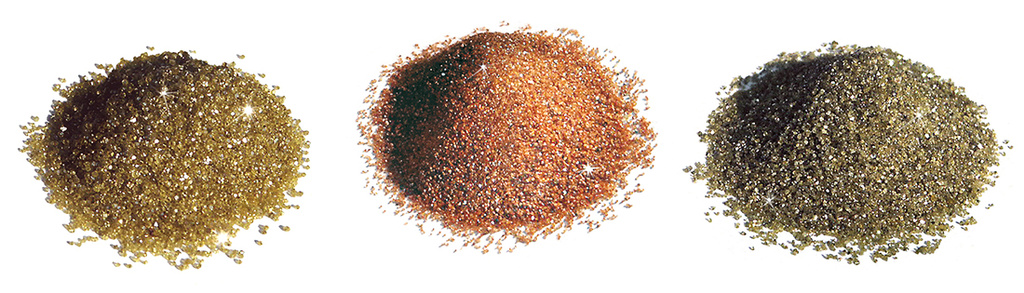
The basis and thus the most important component of each honing stone is the abrasive. Synthetic diamonds or cubic boron nitride (CBN) in various grit sizes are used.

The second component is the metal bonding which is responsible for the proper adhesion of the abrasive crystals warranting excellent wear performance.

The copper-plated steel blank is the third and last component and is the support material of each stone in a drawn, galvanized form.

Abrasives 1
Abrasives 1
Abrasives 2
Abrasives 2
Abrasives 3
Abrasives 3

Honing Stones

Standard Honing Stone
Slotted Standard Honing Stone
Solid Honing Stone
Solid Honing Stone
Standard Honing Stone Type T
Compact Honing Stone
Standard/Compact or Solid Honing Stone Type G
Solid Honing Stone Type P

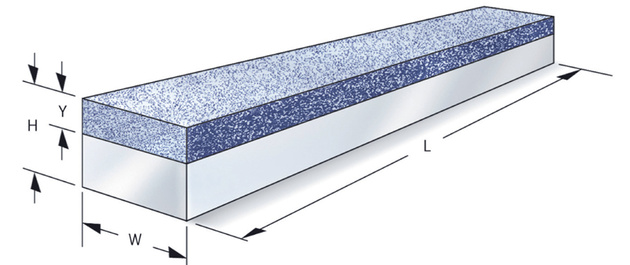
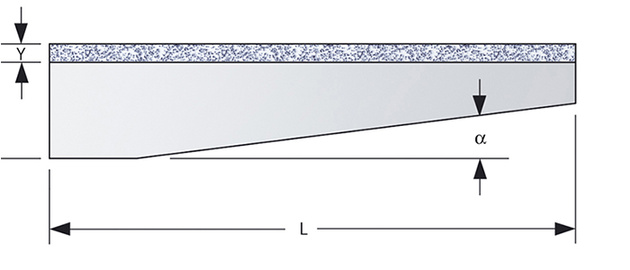
Standard Honing Stone

The abrasive layer is produced with a steel blank and the honing stone is soldered or bonded onto the stone holder of the tool.
How to order: W x H x L x Y
Example: 5.00 x 6.00 x 100.00 x 2.0

Slotted Standard Honing Stone

The same structure as for the standard honing stone only with longitudinally slotted abrasive.
How to order: W x H x L x Y x S
Example: 6.00 x 6.00 x 80.00 x 2.5 S 2.0

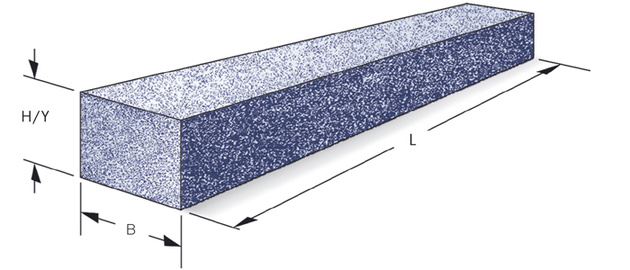
Solid Honing Stone

Consists only of an abrasive layer without a steel blank and is also soldered or bonded onto the stone holder/holder segment of the tool.
How to order: W x H x L x Y
Example: 3.00 x 2.00 x 60.00 x 2.0

Standard Honing Stone Type T

Stone with T-shaped profile with a narrow reduced section and a short wide work element in the lower area.
How to order: W x H x L x Y G x L'
Example: 3.00 x 3.00 x 45.00 x 2.0 G 7.5

Compact Honing Stone

A ready to be installed stone for direct use in the tool body. This stone type is used in tooling systems for the machining of high precision bores. In general, the structural form is rounded angular.
How to order: W x H x L x Y
Stone drawings required
Example: 3.00 x 7.40 x 40.00 x 1.0

Standard/Compact or Solid Honing Stone Type G

Honing stone with upper and lower guide arranged symmetrically
How to order: W x H x L x Y G x L'
Example: 3.00 x 3.00 x 45.00 x 2.0 G 7.5

Solid Honing Stone Type P

Honing stone with narrow cutting part and lateral guides which are arranged symmetrically. Application: Cylinder blocks and bushings
How to order: W x H x L x Y P W'
Example: 6.00 x 5.00 x 80.00 x 2.0 P 1.5
(Stone width W not equal to stone height H)

Microscope image: Individual crystals
Microscope image: Bonding material

Specifications


The specification defines the exact composition of the respective abrasive layer of each honing stone. Each individual component directly influences the cutting characteristics and quality of the bores to be honed. In principle, the following four components need to be taken into account:

The Concentration

describes the number of carats of diamond or boron nitride crystal per cm³ in the abrasive layer.

The Type of Bond

and its characteristics are determined by the stability of shape, the wear performance and the adhesion of the cutting crystal. Whether a bond has to be hard, tough or brittle depends on the material which is to be honed.

The Types of Crystal

are available in various forms depending on the process parameters for the diamond synthesis. They differ in colour, hardness, form, structure and stability. These characteristics also determine the cutting behavior of each respective crystal.

The Grit Size

generally determines the achievable depth of roughness or surface profile and is responsible for the stock removal capacity of the honing stone. This means that "coarse" grit sizes are used for rough honing in order to be able to make use of the high cutting efficiency. In the case of finish honing on the other hand, "fine" grit sizes are used to obtain low surface profiles.


Map

NEWS

April 2012
Gehring at the Mach in Birmingham

Gehring demonstrates the new deephone at this year's MACH. more »

March 2012
Max Smart recommends the new smarthone

small machine - big impact!more »